 Side profile
F-02 — Line F
White Care Kit
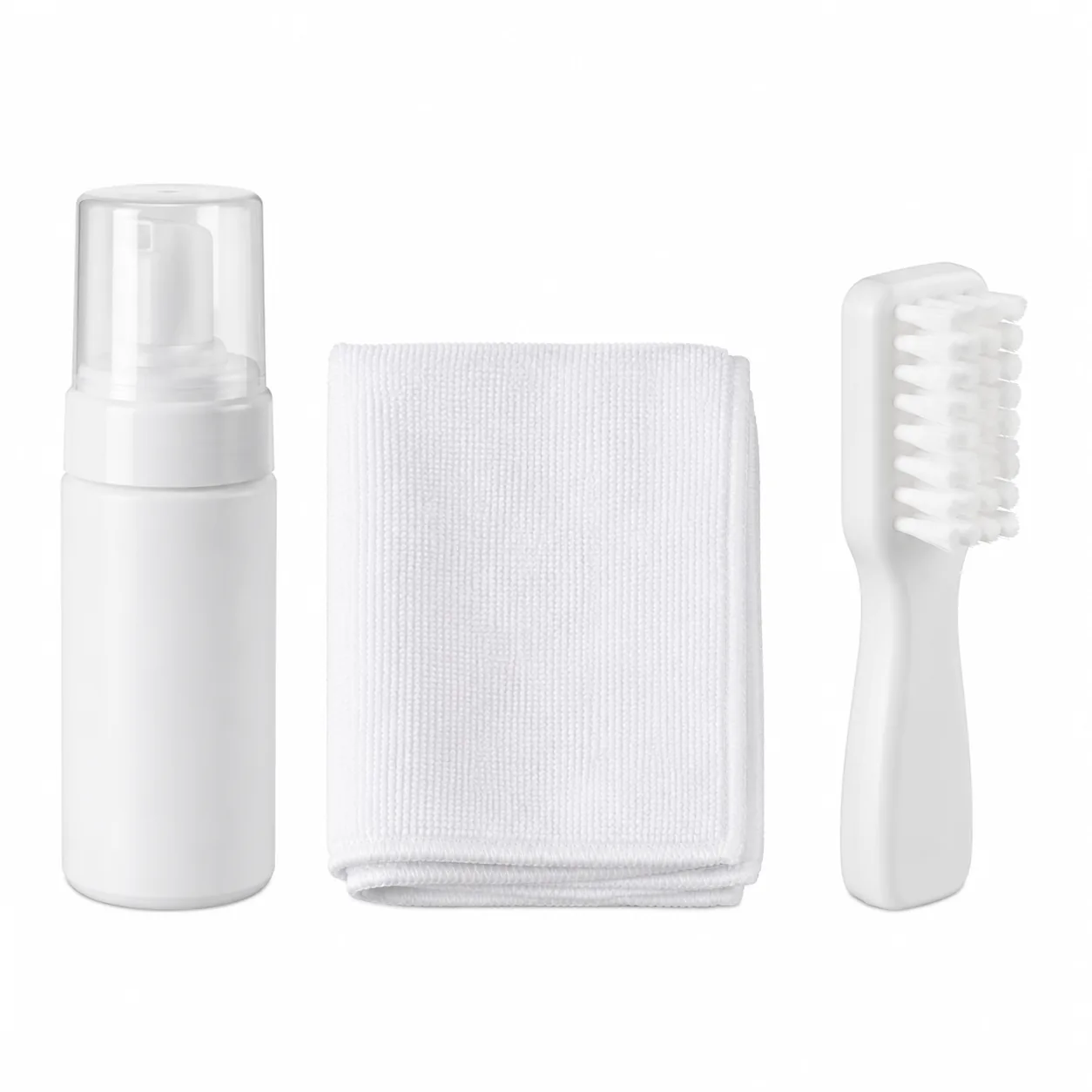
Foam cleaner, cloth and a stiff midsole brush. Built for the white uppers and the white rubber under them, which need different things.
$38USD, one-off purchase
Composition
| Cleaner | Water, non-ionic surfactants, preservative. pH 7.0 ± 0.5 |
|---|---|
| Brush | Polypropylene bristle, polypropylene handle |
| Cloth | 80% polyester, 20% polyamide microfibre |
This is not footwear, so the three-row footwear label does not apply. We publish the composition anyway.
Adding does not open the cart. The count in the header goes up by one.
- Free standard shipping over $129. Below that it is $12. Delivery windows
- 14 days to withdraw without giving a reason. Try them indoors on carpet. Livre resolução
- 3-year legal guarantee of conformity under Portuguese law. Garantia
- Livro de Reclamações Eletrónico
Specification
Everything we measured.
Figures are taken from a size EU 42 unless a range is given, and they are the same figures we hold in production.
Build
- 01
- 200 ml pH-neutral foam cleaner, suitable for smooth and coated leather and for cotton canvas.
- 02
- Stiff-bristle brush sized for a midsole, soft cloth for the upper.
- 03
- Contains no bleach and no optical brightener. Both of those make yellowing worse over time.
- 04
- It removes dirt. It does not reverse yellowing, and nothing in this kit claims to.
Chemical compliance
- Chromium VI in leather
- ≤ 3 mg/kg
- Azo dyes
- Within REACH Annex XVII limits
- Nickel release, metal eyelets
- Within REACH Annex XVII limits
How this pair is cleaned, and what will not come out.
Smooth and coated leather
- 01Take the laces out. They hold most of the dirt and they wash separately.
- 02Brush loose dust off dry with a soft brush before any water touches the shoe.
- 03Work a pH-neutral foam over the panel with a damp cloth, in circles, one panel at a time.
- 04Wipe the foam off with a second cloth, clean and barely damp. Do not let it dry on the leather.
- 05Stuff the shoe with paper and dry it away from radiators and sun, for at least twelve hours.
- 06On uncoated leather, finish with a colourless cream once a month if the surface looks dry.
Comes out
- Dust and dry street dirt
- Dry scuff marks that sit on the surface
- Water-based food marks caught the same day
- Salt tide marks from winter pavements
- Grey transfer from rubbing against a bag or a doorframe
Stays
- Oil and grease, once absorbed — the surface is porous and the oil goes in, not on
- Dye lifted from dark denim or a dark car seat into pale leather
- Ink
- Deep cuts and abrasions through the finish, which can be filled but not undone
- Heat damage from drying on a radiator, which shrinks and hardens the fibre permanently
- Never put these in a washing machine. The drum separates the sole from the upper.
- Never use bleach or a cleaner containing optical brightener. Both accelerate yellowing.
- Never dry them with heat.
- On coated leather, never use a solvent-based cleaner: it lifts the coating along with the mark.
Cotton canvas and woven textile
- 01Remove the laces and the insock and wash both separately by hand.
- 02Brush dry dirt out of the weave with a medium brush.
- 03Work cool water and a little neutral detergent into the fabric with a soft brush, in small circles.
- 04Rinse by wiping with a clean damp cloth several times. Do not hold the shoe under a tap.
- 05Stuff with white paper — coloured paper transfers dye into wet canvas — and dry in the shade for a full day.
Comes out
- Mud and dust
- Most water-based food and drink marks caught early
- Grass marks, partially
- Surface grime across the whole upper, which lifts evenly if you treat the whole panel
Stays
- Oil and grease, which sit between the yarns rather than on them
- Ink and dye transfer
- Yellowing of undyed cotton, which bleach makes worse rather than better
- Stretch: canvas that has given does not come back
- Never put these in a washing machine or a tumble dryer. Heat and the drum separate the sole from the upper.
- Never use bleach or a brightener on undyed cotton.
- Never dry them in direct sun, which drives yellowing.
Rubber midsole and outsole
- 01Work a stiff short-bristle brush with foam cleaner along the midsole, not across it.
- 02Run the brush into the join between sole and upper, where the grey collects first.
- 03Wipe the foam off before it dries, or it leaves a tidemark of its own.
- 04For the tread, a brush and plain water is enough. Do not soak the shoe to clean the bottom of it.
Comes out
- Grey street film, which is most of what makes a white midsole look old
- Scuffs from kerbs, mostly
- Marks at the join between sole and upper
Stays
- Yellowing of the rubber itself, which is oxidation through the material rather than dirt on it
- Cuts and gouges in the rubber
- Tar
- Never use acetone or a solvent on rubber: it softens the compound and it attacks the cement at the join.
- Never soak a shoe to clean its sole.
- Never use a whitening product that relies on bleach. It sets the yellow rather than lifting it.